Merging Probability Assessments and Psychological Dynamics in Long-Form Gaming Sessions

Extended gaming sessions require players to balance numerical probability assessments with shifting psychological states, and researchers have documented how these elements interact over time. Data from multiple studies indicate that cognitive fatigue often emerges after four to six hours of continuous play, leading participants to deviate from calculated risk models even when statistical information remains available on screen or in reference materials.
Probability assessments in gaming rely on concepts such as expected value calculations, variance measures, and conditional probabilities that update with each outcome. Psychological factors, meanwhile, encompass attention span, emotional regulation, and decision-making biases that researchers track through controlled observation and self-report instruments. When these domains intersect during prolonged sessions, performance metrics frequently show measurable changes rather than stable adherence to initial strategies.
Core Components of Probability Integration
Players who maintain records of hand frequencies or reel outcomes can apply basic statistical tools to adjust bet sizing or game selection mid-session. Studies conducted by academic groups have shown that those who reference running tallies of observed versus theoretical frequencies tend to preserve closer alignment with optimal expected values for longer periods than individuals relying solely on memory. Yet psychological elements such as overconfidence after short winning streaks can override these records, prompting larger wagers that increase exposure to variance.
Session length directly influences the accuracy of mental probability models. After approximately three hours, error rates in recalling prior outcomes rise according to findings from laboratory simulations, while real-world data collected through player tracking systems reveal similar patterns across different game types. Incorporating external aids like digital probability calculators helps mitigate some of these recall issues, though adoption rates remain variable depending on venue policies and individual habits.
Psychological Influences on Extended Play
Cognitive biases documented in gaming research include the gambler's fallacy and loss-chasing tendencies, both of which become more pronounced as session duration extends. Observers note that participants who experience consecutive losses sometimes increase bet amounts in attempts to recover, even when probability tables indicate that such adjustments do not alter long-term expected returns. Emotional states tracked via heart-rate monitors and facial-expression analysis in experimental settings correlate with these behavioral shifts.
Fatigue represents another documented factor. Research teams at several universities have measured declines in working memory capacity after sustained periods of focused attention, resulting in slower processing of updated probability information. In environments where multiple games run simultaneously, this slowdown can compound, leading players to default to habitual choices rather than recalculated options based on current odds.
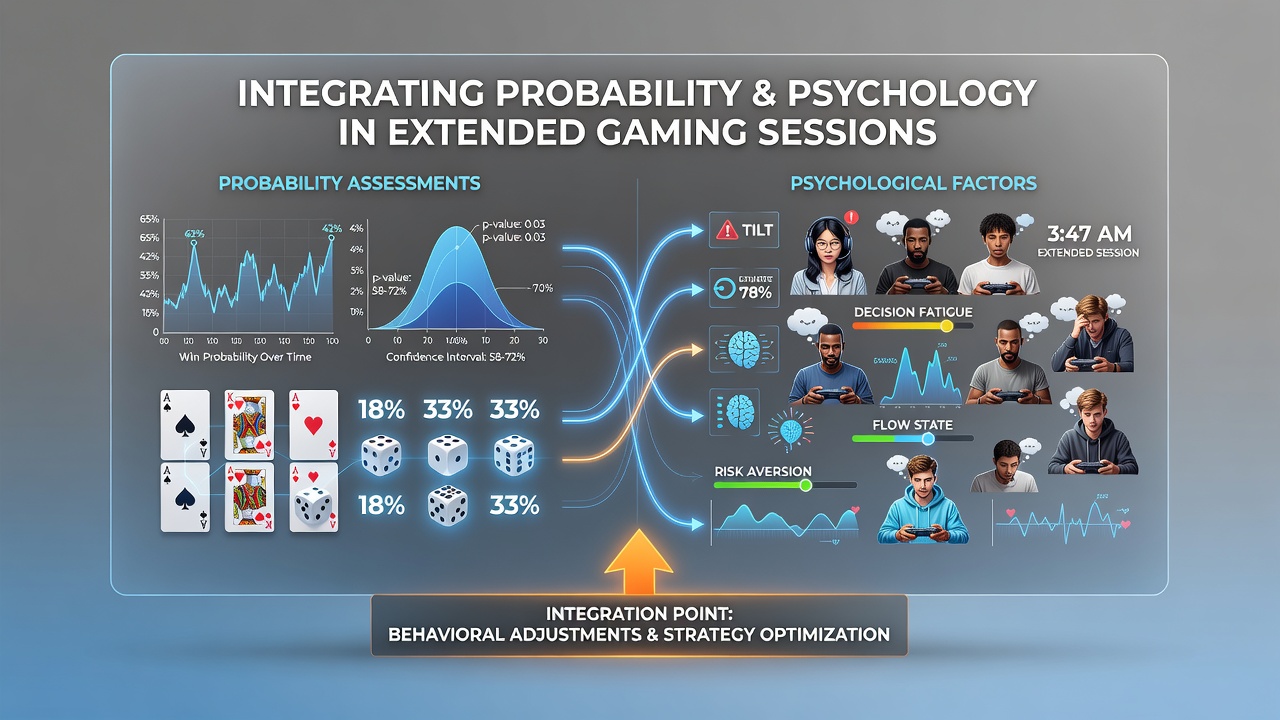
Methods for Combining Both Elements
Structured break protocols offer one approach that combines probability tracking with psychological monitoring. Session logs maintained by participants in controlled trials demonstrate that inserting brief pauses every ninety minutes allows reassessment of both statistical position and mental state before continuing. During these intervals, individuals can review deviation metrics from expected frequencies while also completing short self-assessment scales for alertness and emotional tone.
Training programs developed by industry research organizations teach recognition of personal thresholds where psychological drift begins to affect probability adherence. Participants in such programs receive instruction on identifying early signs such as increased decision speed or repeated disregard of reference charts. Follow-up evaluations indicate measurable retention of these skills across multiple sessions when practice occurs under supervised conditions.
Technology-assisted tools have expanded options for real-time integration. Applications that overlay probability readouts with simple biometric feedback allow users to cross-reference numerical data against indicators of rising stress or diminishing focus. Reports from pilot implementations in North American and Australian venues show varying uptake, influenced by factors including interface simplicity and regulatory permissions around data collection.
Observational Data and Case Patterns
Analyses of player behavior logs collected through loyalty systems reveal clusters of extended sessions where early adherence to probability guidelines gives way to more impulsive selections after several hours. One study tracking thousands of individual records found that average bet variance increased notably beyond the five-hour mark, consistent with psychological literature on sustained attention limits. Similar patterns appear in both land-based and digital environments according to aggregated reports.
Take one researcher who examined tournament poker participants across multi-day events. That investigation documented how players who maintained separate probability journals alongside brief psychological check-ins preserved tighter ranges of decision quality compared with those focused exclusively on either domain. The findings align with broader evidence that dual monitoring reduces cumulative drift in extended formats.
Conclusion
Integration of probability assessments with psychological factors during extended gaming sessions rests on documented interactions between statistical models and cognitive states. Evidence from academic and industry sources shows that structured monitoring, periodic reassessment, and auxiliary tools can support continued alignment with calculated expectations even as session length increases. Patterns observed through June 2026 continue to highlight the value of addressing both numerical and mental dimensions concurrently rather than in isolation.