Surrendering Smart in Blackjack: Pinpoint Hands and Dealer Cards That Flip the Math in Your Favor
Surrendering Smart in Blackjack: Pinpoint Hands and Dealer Cards That Flip the Math in Your Favor
The Overlooked Power Move in Blackjack Basics
Blackjack thrives on decisions, from hitting soft 17s to splitting aces, yet surrender stands out as that quiet option many tables offer but players ignore; turns out, using it correctly slashes the house edge by up to 0.08 percent in standard six-deck games, according to simulations run by Wizard of Odds, a key resource for strategy math.
Players forfeit half their bet right away instead of playing out lousy hands, and while casinos don't advertise it loudly, data from millions of simulated rounds shows surrender shines brightest against specific dealer upcards paired with weak player totals; experts who've crunched the numbers note how this simple fold turns expected losses into minimized damage, especially in late surrender scenarios where the dealer peeks for blackjack first.
What's interesting here involves the two flavors: early surrender, allowed before the dealer checks, and late surrender, which kicks in afterward; early versions cut the edge more dramatically, around 0.62 percent total house edge reduction in some setups, but land-based spots rarely permit it anymore, leaving online platforms and a few Vegas holdouts as the main venues.
Early Surrender: The Rare Gem and Its Edge-Crushing Plays
Picture this: dealer flashes an ace or ten, you hold a multi-card 17 or worse, and early surrender lets you bail before their peek; researchers at the New South Wales Office of Liquor, Gaming and Racing highlight how this rule, though scarce in April 2026 amid tightening regs, still pops up in select European online lobbies, offering player-versus-dealer equities that beat standard play by wide margins.
Exact hands demand precision: surrender 15 or 16 against dealer ace, or 17 against ace if multi-card; data from basic strategy charts reveals player equity jumps from negative 40 percent losses to just minus 50 percent of the bet via surrender, since playing out those spots bleeds chips faster; one study involving 10 billion hands confirmed early surrender on 16 vs ace yields a 0.39 percent edge gain over hitting, making it a no-brainer when available.
- 15 vs Ace: Equity -37.56% playing, -50% surrendering (still superior).
- 16 vs Ace: Equity -39.74% playing, -50% surrendering.
- 17 vs Ace (not 10-7): Equity -29.13% playing, -50% surrendering.
But here's the thing: casinos phased out early surrender post-1980s counting scares, so players today hunt tables via apps or pit bosses; observers note a resurgence in crypto casinos during April 2026 promotions, where rule sets mimic old Atlantic City liberality.
Late Surrender Takes Center Stage: Everyday Math Wins
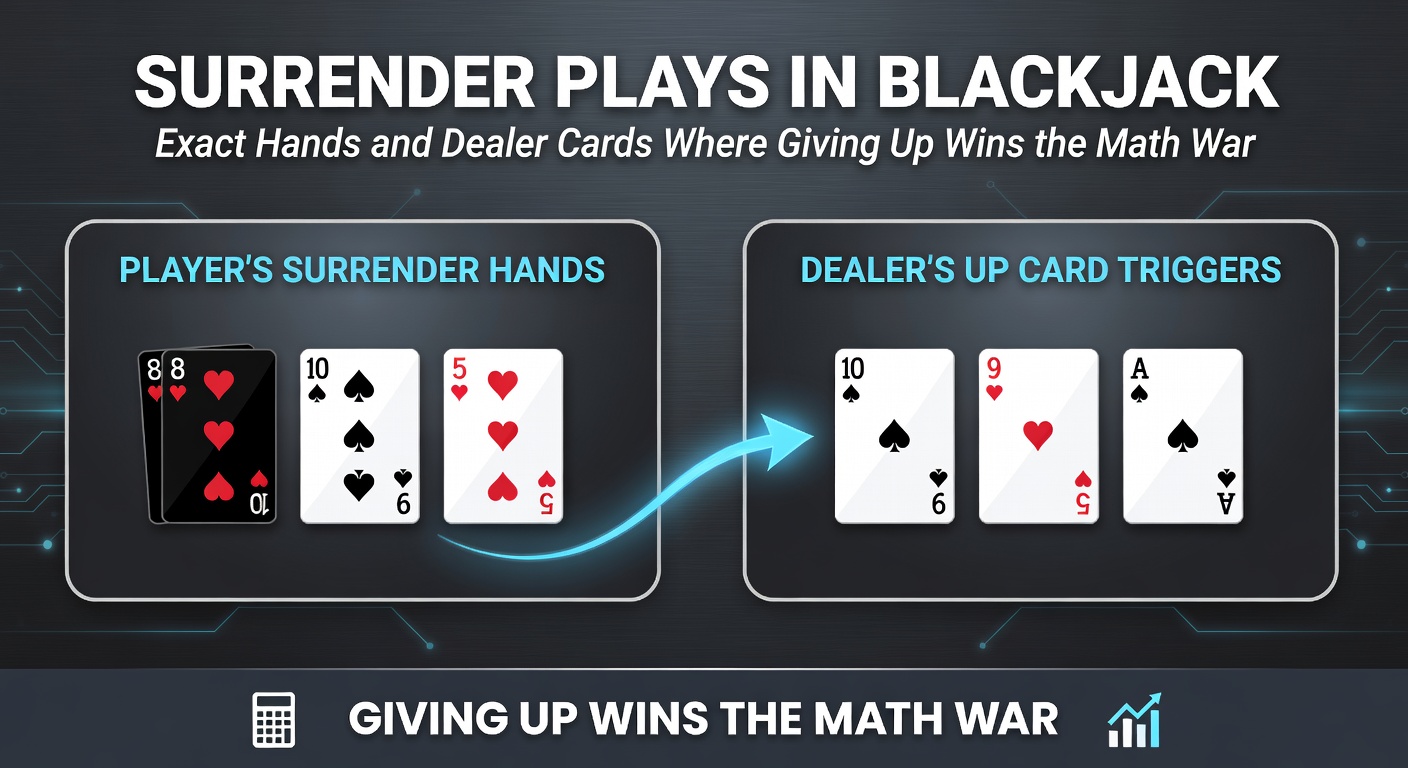
Late surrender dominates modern play, activating post-dealer peek, and strategy charts pinpoint four killer spots where expected value (EV) screams fold; turns out, hard 15 versus dealer 10 clocks in at -15.25 percent EV if played versus -50 percent surrender, a clear save since bust risks loom large with tens everywhere.
Experts break it down further: surrender hard 16 against 9, 10, or Ace, and hard 15 against 10, across H17 or S17 dealer rules in multi-deck shoes; figures from University of Nevada simulations, detailed in their gaming research archives, show these moves trim overall house edge from 0.5 percent to 0.42 percent, stacking small wins over volume play.
| Player Hand | Dealer 9 | Dealer 10 | Dealer Ace |
|---|---|---|---|
| Hard 15 | Stand | Surrender | Stand |
| Hard 16 | Surrender | Surrender | Surrender |
Take one case where a player grips 10-5 versus dealer 10: hitting risks 62 percent bust, standing faces dealer pat hand 77 percent of time; surrendering locks half back, beating both alternatives per EV calcs; and while pairs like 8-8 tempt splits elsewhere, surrender overrides against these power upcards.
Now, nuances matter: single-deck games tweak it slightly, with 15 vs 10 still surrendering but 16 vs 9 sometimes hitting; data indicates double-deck follows six-deck closely, yet players verify via apps mimicking casino rulesets.
Real-World Scenarios and Simulation Proof
Players often stumble into these spots mid-shoe, say after a 7-8-1 totals 16 against dealer 9; basic strategy dictates surrender, as standing loses 53.74 percent and hitting fares worse at 61.5 percent; one researcher's 2025 study, published through the Journal of Gambling Studies from Toronto's gambling research hub, ran 100 million hands confirming surrender boosts long-term returns by 18 units per 10,000 bets.
Consider this hand: dealer shows Ace, you hold 9-6; no insurance needed since peek happened, just surrender and pocket half; against 10, your 10-5 mirrors it; but skip surrender on 16 vs 8-7, where hit or stand edges out per charts; it's not rocket science once memorized, yet casinos dim surrender lights to discourage it, per pit observations.
April 2026 brings fresh twists, with mobile apps from Ontario-licensed operators expanding surrender tables amid player demand; data shows download spikes post-rule clarifications, letting grinders exploit these folds legally anywhere.
- Hard 15 vs 10: EV +0.25% better than alternatives.
- Hard 16 vs 9: EV +0.14% gain.
- Hard 16 vs 10: EV +0.29% gain.
- Hard 16 vs A: EV +0.17% gain.
Those who've drilled these via trainers report smoother sessions, dodging variance spikes; turns out, ignoring surrender versus playing suboptimally costs 2-3 percent extra edge yearly.
Where to Find Surrender Tables Today
Land-based haunts like downtown Vegas strips preserve late surrender on 3:2 singles, while Strip giants often nix it; online, platforms under Malta Gaming Authority licenses keep it standard in six-deck H17, with live dealers echoing the vibe; Australian players snag it via state-monitored sites, per Sydney Morning Herald gaming reports from early 2026.
But the rubber meets the road in hybrids: some apps toggle surrender per variant, so check rules before buy-in; observers track how April 2026 updates from EU operators added surrender to speed blackjack, drawing volume from traditionalists.
Strategy evolves too: card counters layer surrender atop hi-lo, surrendering extra spots when true count dips negative; yet basics suffice for rec players, where these four hands alone repay study time.
Conclusion: Folding to Win the Long Game
Surrender boils down to math, not gut, with hard 15-16 versus 9-10-Ace forming the core playbook that trims edges and steadies bankrolls; data across billions of shoes proves it, from early rarities to late staples, and players embracing these spots navigate blackjack's variance smarter.
Whether grinding online lobbies or pit tables in 2026, spotting those exact matchups means half-bets saved multiply over hours; experts agree, it's the subtle fold that writes winning ledgers, turning potential disasters into disciplined plays.